Air Operations, Carolines
In the first offensive mission launched from Guam, 2 30th Heavy Bomb Group B-24s attack the Yap Atoll.
[
 |
| 
 ]
]Air Operations, CBI
BURMA- 15 10th Air Force P-47s attack three rail bridges in northern Burma.
- 15 P-47s support Allied ground forces around Mohnyin.
- 12 P-47s attack Japanese Army positions around Bhamo and Muse.
- 6 P-47s attack a bridge spanning the Paungni River.
- 4 P-47s attack Mawhun.
- 3 341st Medium Bomb Group B-25s and 14th Air Force P-40s and P-51s mount more than 130 effective sorties against bridges, shipping, occupied towns, artillery batteries, road traffic, and other targets across southern China.
| ]Air Operations, East Indies
- FEAF B-24s attack Parepare, Celebes.
- FEAF fighter-bombers attack the town area at Amboina, the Boela airfield on Ceram, and supplies at Kaoe Bay, Halmahera.
| ]Air Operations, Europe
RAF BOMBER COMMANDDaylight Ops:
- 75 Lancasters of No. 3 Group carry out an accurate attack on a coastal battery at Flushing.
- 1 Lancaster is lost.
- 2 Wellingtons fly signals patrols.
- 242 Halifaxes of Nos. 4 and 6 Groups and 21 Pathfinder Lancasters are sent to Hannover. The planes are recalled, however, because of deteriorating weather in England. All planes return safely.
- 4 Mosquitos are sent to Pforzheim and 2 each to Cologne and Düsseldorf, and 7 aircraft lay mines in an unrecorded area.
- There are no losses.
ETO:
- 9th Air Force fighter-bombers support US Army ground forces in northern Europe.
ITALY:
- 12th Air Force B-26s attack a rail bridge and causeway.
- XXII TAC P-47s attack numerous targets in support of the US 5th Army.
HUNGARY:
- 104 15th Air Force B-24s attack the airdromes and marshalling yards at Gyor and Szombathely, and nearly 100 escorting P-38s strafe the Szombathely and Seregelytes Airdromes and several rail lines near Lake Balaton.
| ]Air Operations, New Guinea
V Fighter Command fighter-bombers attack the Mongosah and Sagan airfields.
[ | ]Air Operations, Philippines
- Carrier aircraft from Task Group 38.2 and Task Group 38.3 attack airfields in the Visayan Islands.
- Task Group 77.4 escort-carrier TBMs and fighter-bombers mount 360 effective sorties in direct support of US 6th Army ground forces.
- FEAF B-24s attack targets in the Cagayan River valley on Luzon.
- FEAF B-25s and fighter-bombers attack a town and a truck convoy on Mindanao.
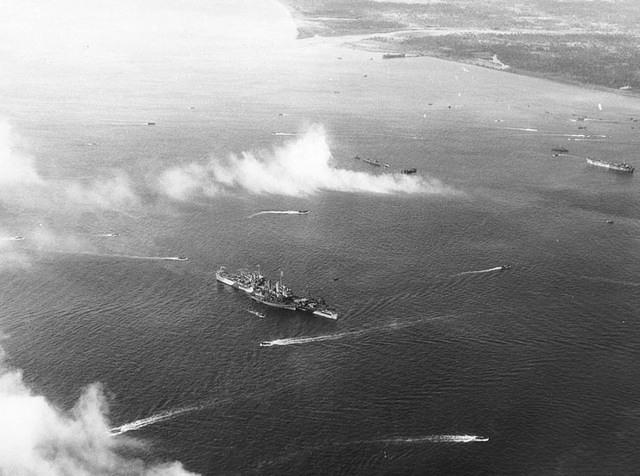
- After a Royal Australian cruiser is damaged in the morning by a kamikaze, Task Unit 77.4.1 aircraft begin sweeping airfields on Cebu, Negros, Panay, and northern Mindanao in the hope of cutting off anti-shipping attacks at the source. 31 Japanese aircraft (possibly including dummies) are destroyed on the ground at the Lahug airfield on Cebu by VF-26 F6Fs. Such sweeps will become routine. US carrier fighters down 3 Ki-46 'Dinah' reconnaissance planes, 2 Ki-21 'Sally' bombers, 2 B5N 'Kate' torpedo bombers, 3 G4M 'Betty' bombers, 1 Ki-49 'Helen' bomber, and 4 fighters over the central Philippines between 0730 and 0955 hours. A VF-18 F6F downs a P1Y 'Galaxy' bomber 25 miles from the carriers at 1115 hours.
| ]Air Operations, Volcano Islands
- 28 30th Heavy Bomb Group B-24s based at Saipan attack Iwo Jima.
- A 318th Fighter Group P-47 downs a Ki-45 'Nick' fighter near Iwo Jima at noon.
| ]Eastern Front
The leading units of Rodion Malinovsky's 2nd Ukraine Front push on west of Szeged, reaching the Danube at Baja east of Pécs in southern Hungary. In Yugoslavia the German Army Groups F under Maximilian von Weichs and E under Alexander Löhr abandon one position after another, menaced all the time by the Bulgarian 1st Army on the eastern flank and elsewhere by Yugoslav and Albanian partisans. The Russians, after their thrust against Belgrade, now concentrate on Hungary. In Finland the Karelia Front under Kiril Meretskov advances from Petsamo with the 14th Army toward the Norwegian border, driving back the German 20th Mountain Army under Lothar Rendulic.
FINLANDThe Soviert XCIX Rifle Corps attempts to reach the Norwegian border between Rova and Salmiiarvi but is held up by strong German resistance. It reaches the border by the evening of the 22nd. Meanwhile, the CXXVI Light Rifle Corps reaches the main road leading north from Akhmalakhti to Kirkenes but is then forced to halt due to ammunition and food shortages.
The Soviet XXXI and CXXVII Rifle Corps are closing in on Nikel. However, an assault by German troops allows 1,000 of their comrades in the Nikel area to withdraw and escape the Soviet trap. In fact, the Germans are pulling back from Nikel, Akhmalakhti and Salmiiarvi.[MORE]
[ | ]Italy
US 5th ArmyOn the west side of the Allied line, while the South African 6th Armored Division completes the capture of Monte Alcino, there is no change in the positions of the II Corps.
In the British XIII Corps area, the 38th Brigade of the 78th Division makes another unsuccessful attempt to take Monte Spadura. The 21st Brigade, Indian 8th Division, pushes almost to the summit of Monte Romano.
British 8th ArmyIn the Polish II Corps area, the Kresowa 5th Division, pressing northwestward toward Route 67, which leads to Forlì, takes Strada San Zeno in the Rabbi River valley and the summit of Monte Grosso.
The V Corps expands its 3 bridgeheads across the Savio despite heavy rainfall and rapidly rising water. The Indian 10th Division's 20th Brigade pushes toward Monte Cavallo on the left flank of the corps while the 25th Brigade attacks to expand the bridgehead from San Carlo. The 4th Division completes the capture of Cesena and crosses additional forces over the Savio there, although handicapped by the lack of a permanent bridge.
In the Canadian I Corps area, at 2000, the Canadian 1st Division begins an attack across the Savio with the 2nd Brigade, supported by diversionary fire of the 3rd Brigade, and secures a bridgehead.
[ | ]Pacific
- The cruisers Honolulu (CL-48) and Australia are seriously damaged in a Japanese air attack.
- The British submarine Tantivy sinks Japanese merchant cargo ships No.2 Chokyu Maru, No.3 Takasago Maru and Otori Maru (2105t) in Makassar Strait.
| ]Palau Islands
ANGAURThe Japanese resistance on Angaur, where an airfield has already been prepared to take US heavy bombers, comes to an end. The Japanese have lost 1,300 dead and 45 prisoners and the American 265 dead and 1,335 wounded.
The larger islands in the group are left with their Japanese garrisons isolated and impotent. Already US heavy bombers are operating from Angaur.
[ | ]Philippines
LEYTEThe Japanese decide to make a strong effort to defeat the Americans instead of fighting a delaying action as planned.
6th ArmyGenerals Krueger, Sibert, and Hodge take command ashore of the 6th Army, X Corps, and XXIV Corps respectively.
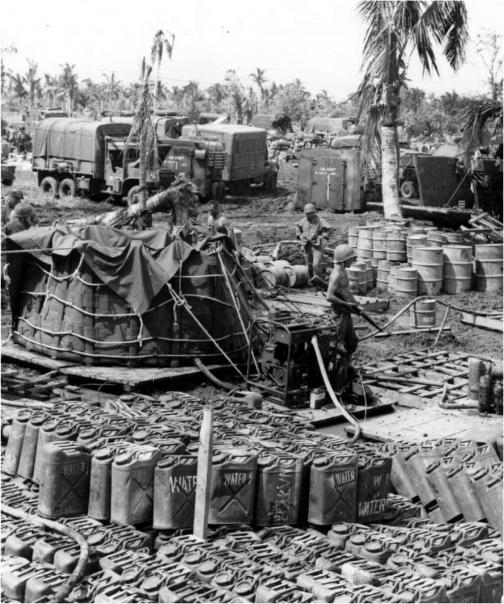
In the X Corps area, the 2nd Brigade (7th Cavalry) of the 1st Cavalry Division seizes Tacloban and the southern half of a hill to the southwest. The 1st Brigade (12th Cavalry on the right and the 5th on the left) drives westward, taking Utap and Caibaan. The 34th Infantry, on the northern flank of the 24th Division, undergoes a determined enemy counterattack, beginning at 0100, in the Pawing area. Artillery and 7th Fleet aircraft assist after daylight in routing the enemy, more than 600 of whom are killed. The 2nd Battalion then attacks a ridge to the west but cannot take it. The 19th Infantry clears the far slope of Hill 522 and, with strong fire support, takes Palo.
In the XXIV Corps area, the 96th Division's 383rd Infantry begins working arount Catmon Hill, which is actually a series of hill positions. The 1st Battalion secures Labiranan Head but, since the Japanese remain in this area, pulls back to the Labiranan River. The 2nd Battalion gains positions 300 yards north of Tigbao and the 3rd Battalion, positions about 1,100 yards northeast of the barrio. The 382nd Infantry drives on Tigbao but is slowed by pillboxes as well as swampy terrain. The 7th Division attacks toward the Dulag and Burauen airfields with the 32nd and 184th Regiments. The 32nd, against considerable opposition, gets forward elements (the 2nd and 3rd Battalions) to the regimental beachhead line. The 184th Infantry easily takes the Dulag airstrip by 0900 and continues westward to positions about 1,000 yards beyond the beachhead line, but a gap exists between it and the 32nd Regiment.
The ships of 7th Fleet and one group of TF 38 give gunfire and air support. Two groups of TF 38 attack targets on Panay, Cebu, Negros and Masbate to the west and northwest of Leyte. Damaged by coastal mortars are LST-269, LST-483, LST-486 and LST-704.
[ | ]Western Front
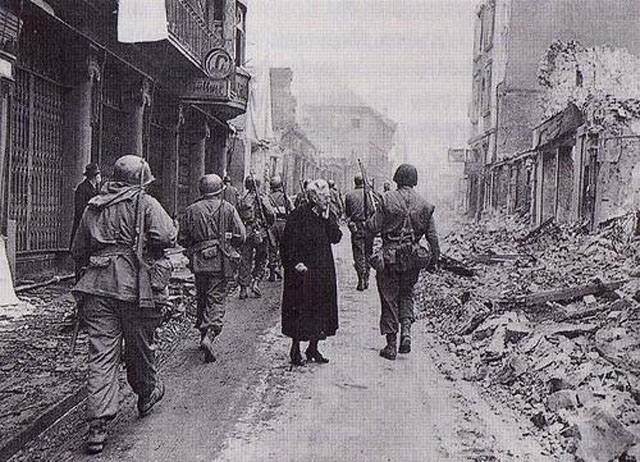
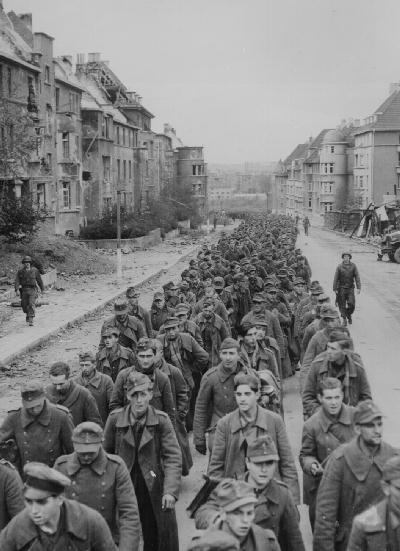
At 12:05p.m. Aachen is surrendered to the American forces. Much of the city has been ruined in the battle, and especially for the Germans, there can be no justification for the continued sacrifice of human lives, either from the strategic point of view or from that of military prestige.
In the American 7th Army sector, units of the 45th Div, VI Corps, enter Brouleveurs, the 3rd Div continues to advance toward St Dié and the 36th Div improves their positions east of Bruyères.[WE]
[ | ]Images from October 21, 1944
|
|
|
|
|
|
|
|