Henry's succession
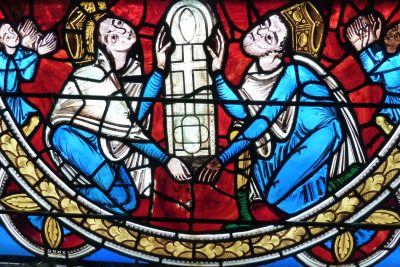
Henry won his final victory in England because the great barons were increasingly reluctant to fight a decisive battle -- whichever side won, a massive confiscation of property would undoubtedly follow. When Stephen and Henry finally faced each other across the Thames at Wallingford in 1153, there was general pressure on Stephen to acknowledge Henry as king of England.
Stephen had quarrelled with the archbishop of Canterbury in 1147, and the Church ever since had refused to confirm his son, Eustace, as his heir. Meanwhile, as a result of Henry's successes in France, and the steady support he enjoyed in England, allegiances has slowly drifted his way; by 1153, great barons like Earl Robert of Leicester were ostensibly on Stephen's side, but in practice had done secret deals with Henry.Stephen had no choice but to come to an agreement with Henry, who was able to leave England confident that he was everywhere accepted at its next king.
|

|