Anarchy and War
|
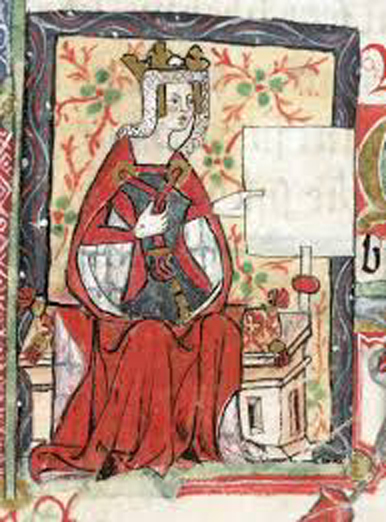
Civil war and local disturbances were prominent features of Stephen's 19-year reign in England. The war of succession began soon after he had seized the crown in 1135, with Matilda's uncle, David, King of Scotland, invading northern England on her behalf in 1138. Conflict deepened when Matilda herself landed at Arundel in 1139, and continued up to and beyond her final departure from England in the early months of 1148. Her son Henry of Anjou, later Henry II, to whom she had transferred her claim, kept up the fight.
The war had its near-decisive moments. In 1141 Stephen was captured at the battle of Lincoln, only to be exchanged against Matilda's half-brother, Earl Robert of Gloucester, who was taken at Winchester in 1142. But is was mostly a struggle of attrition characterized by sieges and small military operations, with Matilda and her supporters entrenched in the West Country and Stephen unable to dislodge them. Matilda was normally on the defensive, occasionally desperately so, as when, in the depths of winter in 1142, with Stephen's army besieging her in Oxford Castle, she had to make a dramatic escape by walking in secret through enemy lines at the dead of night. From 1142 there was a stalemate which neither side came near to breaking.
Both Stephen and Matilda used mercenaries, usually unreliable Flemings. One of these, Robert FitzHubert, a man theoretically in the pay of the earl of Gloucester, captured the strategically crucial castle at Devizes for his patron in 1140 and then attempted to set up his own. Another, Robert FitzHildebrand, took over the castle at Winchester from a fellow supporter of Matilda, seduced his wife, and then came to terms with Stephen. Both came to
miserable ends: FitzHubert was hanged by the earl of Gloucester and FitzHildebrand devoured from within by a tape-worm.
England suffered the devastation typical of this kind of war. Contemporary chroniclers tell a grim story. In the West Country, for example, 'you could see villages with famous names standing solitary and almost empty'. They also tell of construction of castles and of local tyranny.
Such conditions did not prevail everywhere; but the normally peaceful English countryside suffered the consequences of an unremitting struggle in which neither side could fully control its soldiers. Central government disintegrated, with taxes not collected in many regions and coins minted locally by barons. Power was assumed by local lords who where given earldoms by the contenders vying for their support.
Local quarrels were intewoven within the stuggle for the crown. Henry I's reign had left a legacy of claims to property and, soon after his death, violence broke out in, among other places, south Yorkshire and Warwickshire. As a result of rivalries which developed in Stephen's reign, Worcester was sacked twice, in 1139 and 1151. Barons paid off old scores and took property from both sides. Yet, from the late 1140s, they also organized local settlements which brought some measure of order. The treaty between the earls of Chester and Leicester which pacified the north Midlands is an example. Not all of them were greedy opportunists. Most were ordinary men. Ambitious, yet anxious to survive and keep local order, they were caught up in an apparently unending war of succession.
|