A brave and foolish king
|
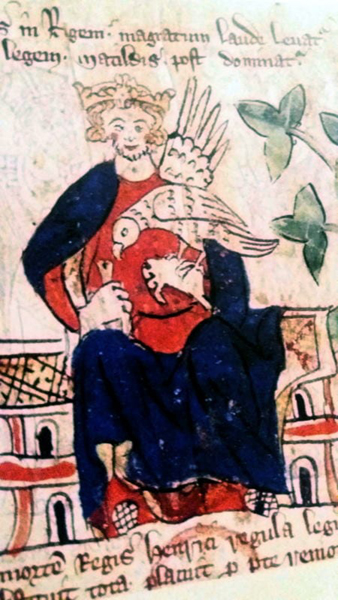
Stephen (?1097-1154) was the third son of Stephen, count of Blois and Chartres, who had acquired European notoriety by running away from Antioch during the First Crusade, and of Adela, the tough-minded daughter of William the Conqueror who sent her husband back to Outremer.
Yound Stephen was dispatched to the court of his uncle Henry I, probably in 1113, and given extensive lands in Normandy and England which made him one of the wealthiest of the Anglo-Norman landholders.
In 1126, along with many others, Stephen took an oath to accept the succession of Henry's daughter Matilda. However, on hearing of Henry's death on 1 December, 1135, he set in motion what seems to have been a premeditated and well-organized plan. He crossed to England, was accepted as king in London, gained possession of the treasury at Winchester, and was crowned on 22 December. A messenger then hurried to Normandy where the Norman barons, after hesitation, accepted him as duke. In this way Stephen re-created Henry I's cross-Channel dominion. Early in 1136 his position seemed secure. His Easter court was attended by many of the major landholders, and even Matilda's half-brother, Earl Robert of Gloucester, had done homage. Matilda and her supporters had been able to occupy only parts of southern Normandy and there were isolated acts
of defiance in the West Country by Baldwin of Redvers, and in the North by the king of Scots.
In the words of the chronicler Walter Map, Stephen was 'a good knight, bu in all other respects a fool' -- a stinging verdict that was perhaps over-harsh. No one doubted Stephen's personal bravery. At the battle of Lincoln on 2 February, 1141, he fought on foot long after much of his army had fled, wering out a battle-axe and a sword before being captured.
He was a chivalrous figure -- courteous, affable, kind-hearted and generous, if somewhat ineffectual when it came to carrying through the schemes he had conceived with such enthusiasm. He could also be sly and shifty, and on many occasions showed a considerable lack of judgement. He made many political blunders during his reign -- arresting barons at court was one -- and alienated vital supporters. On occasions his sense of chivalry led him to make mistakes that asonished and dismayed his followers, as in 1139 when he had Matilda at his mercy but gave her safe-conduct to her brother's castle at Bristol. Because Matilda, as wife of Geoffrey Plantagenet, had a secure base in Anjou and later in Normandy, Stephen had to deal with a combination of external and internal opposition the like of which none of his predecessors had faced. Many people concealed treacherous intent in their apparent loyalty to him. In the end, however, he simply lacked the dominant personality essential to successful 12th-centruy kingship.
|