Aquitaine
The mid-12th century Pilgrims' Book of Compostella descibes the various people who lived in the duchy of Aquitaine. The Poitevins dressed elegantly, were good horsemen, and were witty, hospitable and handsome; in contrast the peoples of the Saintonge and Bordeaux regions spoke uncouthly, while the Gascons were frivolous, talkative, sardonic and debauched but, although far from prosperous themselves, gave generously to the poor. These characterizations should probably not be take too seriously. But they do at least illustrate a medieval view of the diversity of Aquitaine, the largest duchy in France.
Stretching from Poitiers in the north to Périgueux in the south and close to the Rhône valley in the east, the region was extremely wealthy from the export of wine and salt. An astonishingly rich cultural life is typefied on the one hand by such great Romanesque churches as Notre-Dame-la-Grande in Poitiers, the cathedral at Angoulême, the rich carvings on many country churches, and on the other by the Old Provençal love-poetry of William IX, duke of Aquitaine (1086-1126).
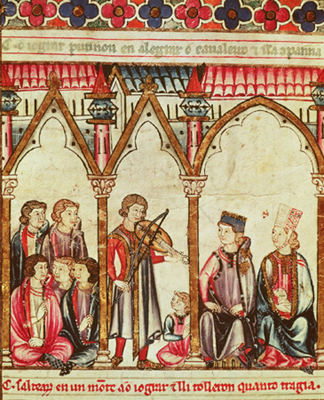
Duke William was the first of the troubadours, a breed in which Aquitaine was to be remarkably prolific. His writings encapsulate a new spirit of chivalry and individualism which was blasphemous, erotic, amoral and sensitive. His poems are an exuberant celebration of love and sensuality that was quite unknown before his time. They contain something of the spirit of renewal that is characteristic of the 12th century, as well as much self-indulgence: 'To refresh my heart in her/To renew my flesh in her/So that I shall never grow old.'
William's life-style was considered outrageous by many contemporaries. A great crusader, he is said to have had his mistress painted on his shield, saying that 'it was his will to bear her in battle, as she had borne him in bed'. As duke, his political legacy was unhappy. His many wars had allowed Aquitaine aristocracy to attain an independence which neither he nor his son, also called William, could curb.
William X ruled from 1126-1137. As he had no male heir, it was decided to marry his young daughter Eleanor to the future king of France, Louis VII, so that the monarchy could protect the duchy. Louis first tried to play an active role in the government of Aquitaine, but subsequently spent little time there. In the long run, the result of the increasing unhappy marriage was to plunge Aquitaine into the rivalry between the Capetians and the house of Anjou.
|
|