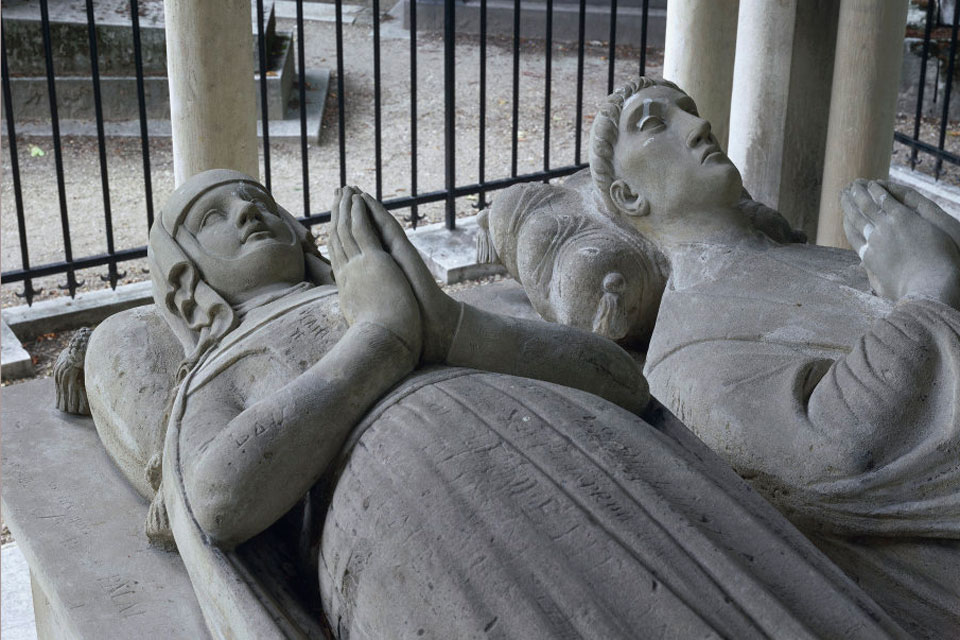
Abelard and Heloise at Père Lachaise in Paris
Abelard and HeloiseAbelard was famous as a teacher in Paris and as an original and provocative theologian, whose abilities placed him at the very heart of western European intellectual life in the 12th century. He was born in Brittany in 1079 and for a number of years lived as a wandering scholar, typical of an age when there were as yet no established universities, and masters at various centres competed ferociously for pupils. Abelard's account of hist life, Historia calamitatum (The History of his Calamaties), shows how he destoyed the ideas and reputations of several of his teachers with an arrogance that made him enemies. By his late 30s he was himself a master in Paris, where his brilliance brought him crowds of pupils and established the basis for the city's great university. In Paris, at the height of his fame he met and fell in love with Heloise, some 20 years his junior. She was the beautiful and learned niece of Fulbert, a canon of Notre-Dame Cathedral. In a Church where celibacy was expected, if not yet absolutely required, the liaison would have been harmful to his career, but not disastrous. |
But Heloise gave birth to a son and although a secret marriage was held to appease Fulbert, the canon continued to ill-treat her so that Abelard eventually took her to the convent at Argenteuil. Believing that Abelard intended to abandon his niece to the life of a nun, Fulbert wreaked a terrible revenge--his servants were sent to break into Abelard's room at night and castrate him. Abelard, filled with horror and humiliation, became a monk at the great royal abbey of Saint-Denis and, on his instructions, Heloise, even then only 19, despairingly entered the convent to which Abelard had taken her. Abelard's contemporaries regarded him as a dangerous influence: in the 1130s he left Saint-Denis to resume teaching and attacted the opposition of conservatives in the Church, led by the formidable Cistercian abbot Bernard of Clairvaux. Abelard's mistake was to pronounce publicly and persuasively that the Christian faith should be subjected to rational enquiry. As a devoutly religious man, his aim was to deepen understanding, not to undermine faith. But he also adopted the radical position that intention was what mattered in determining whether a sin had been committed. All this was too much for the Church establishment, and he was condemned as a heretic in 1140, two years before his death. |
Today Abelard is remembered as a passionate lover, and the Historia and an exchange of letters with Heloise, written when the two former lovers had retired to monasteries, reveal a deep passion from which neither could release themselves. Imbued with the conventions of their time, they agonized over their enjoyment of sexual pleasure. They appear less concerned with society's reactions to the relationship that with the parallels with Adam and Eve, and with the destructive consequences of a sinful relationship on the capacity of Abelard to interpret the scriptures. Abelard tries to give spiritual counsel to Heloise, advising her to transform her love for him into love for God, advice which in the end she was able to take. In 1129, Heloise, already prioress of Argenteuil, became abbess of the Paraclete, a convent set up with Abelard's help on the site of an oratory which he head founded. Her learning, dignity, compassion and administrative abilities made her an admired and respected figure. Eight centuries after their deaths, in the 19th century, the lovers' tombs were placed together in the cemetery of Père-Lachaise in Paris, where flowers are still brought to their ornate memorial. |
Abelard and Heloise at Père Lachaise in Paris |
|