The black monks of St
Benedict
In the great age of European monasticism -- the 11th and 12th centuries -- Benedictine monks were the most influential of all practitioners of the Christian religious life. Amidst the bewildering variety of monastic communities in Europe, the Benedictines of black monks -- so called because they customarily wore black habits -- owed their cohesion and success to the monastic rule originally compiled by St Benedict some years before he died at his famous foundation of Monte Cassino in Italy, during the first half of the 6th century. Simply but elegantly written, and described by its author as 'a little rule for beginners', it regulated the practice as well as the theory of the religious life. Supreme power was entrusted to the abbot, who was expected to 'do all things with the counsel of hist brethren' but to be in complete controlof the spiritual and material welfare of his community. The rule laid particular stress on the vows of obedience and stability; and at the centre of the monastic life lay the opus dei, the regular performance of communal acts of worship in the choir of the abbey's church. Benedictine monks were also committed to a regular routine which normally comprised four hours of private prayer, four hours of religious reading and four hours of manual labor every day. As far as possible, a Benedictine monastery was to be economically self-supporting.
The rule of St Benedict began to exercise its fulles influence in the two centuries after the abbey of Cluny was founded in Burgundy in 909. During the 11th century at least 70 important -- and often new -- communities of black monks, establishing the first large if informal federation of 'order' of Christian monks in western Europe. It would be hard to exaggerate the popularity of these Benedictine monasteries among the great men of Christendom. Just as Count Fulk Nerra's abbey of Beaulieu-lés-Loches (1004) later served as his burial place, so William the Conqueror was buried two generations afterwards in his own favourite Benedictine foundation of the Abbaye-aux-Hommes at Caen in Normandy.
This Benedictine expansion was especially important in Norman and Plantagenet England in creating magnificent new abbeys and cathedral churches like St Albans and Durham, and in ensuring that monasteries like Westminster, Glastonbury and Peterborough remained the wealthiest religious bodies in the country until the Reformation.
Such outstanding wealth was not without danger to men who were supposed to be living ascetically, withdrawn from the extravagances and cares of the world. By about 1100, new generations of monks were already beginning to argue that the religious life practised in most Benedictine monasteries was by no means as austere and zealous as St Benedict would have wished.
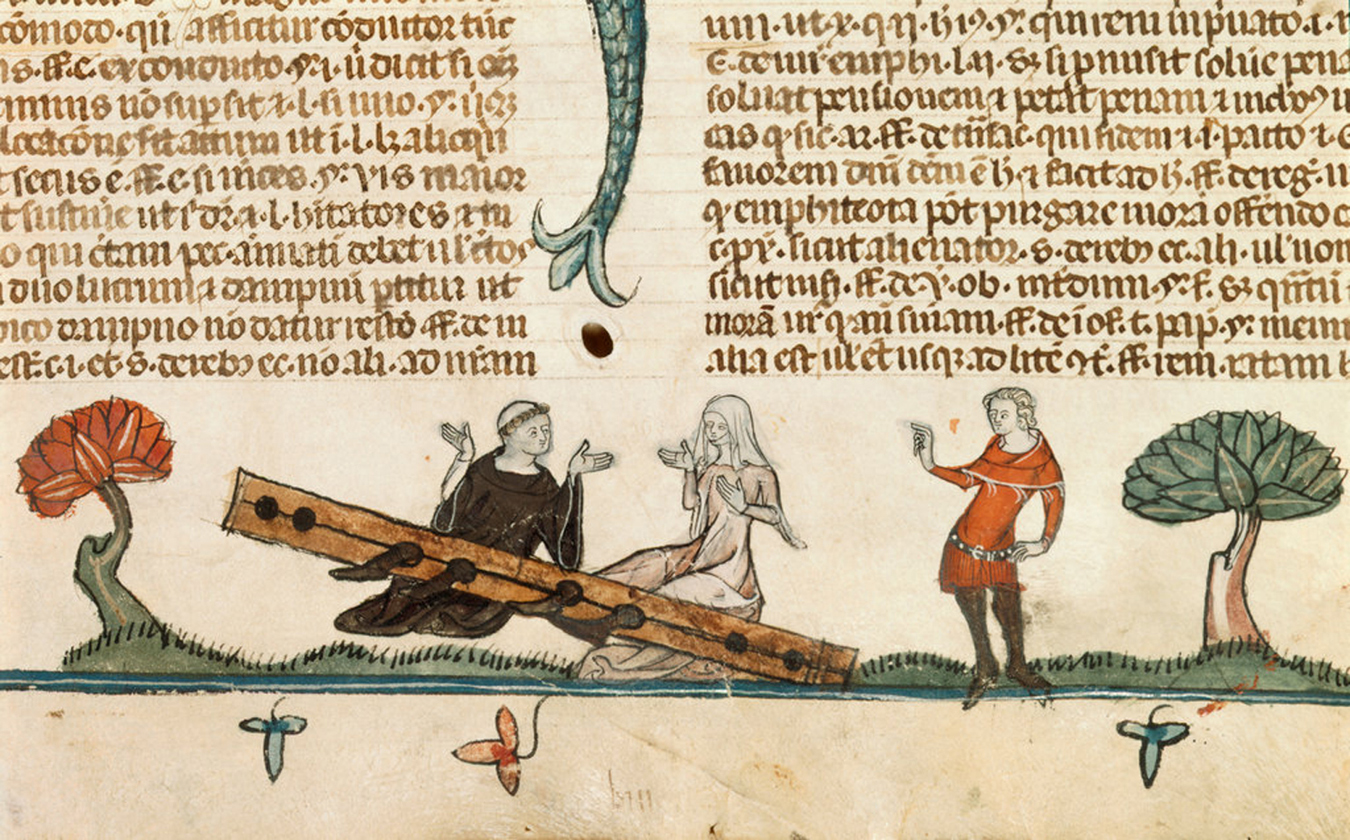
Below A nun and monk are punished for
immoral behaviour with a spell in the stocks.
 |