|
East against WestThe medieval Church was utterly committed to the ideal of Christian unity, but was never able to achieve it. At no time in the Middle Ages was this regrettable failure more obvious than in 1054, when Pope Leo IX sent a diplomatic mission to Constantinople to denounce the partiarch there as a 'disobedient, insolent anad corrupt daughter, sitting at home in peace and lasciviousness, and refusing to take part in the Christian fight waged by her Holy Mother, the Church of Rome'. Not surprisingly, the 'daughter' renounced her loyalty altogether; 1054 was the year in whicn a permanent schism between the Latin Catholic West and the Greek Orthodox East occured. The breach had been long in the making, ever since the first Christian emperor of Rome, Constantine the Great, |
decided to inaugurate the Green city of Byzantium as his Christian capital of Constantinople -- or 'New Rome' -- in 330. Rome and Constantinople were originally allies; but as the papacy or Rome gradually became cut off from Greek influences, it increasingly associated itself with western attitudes. After 752 there were no more Greek or Greek-speaking popes at Rome, while in the still powerful and highly sophisticated Byzantine Empire the patriarchs identified themselves and their Church absolutely with the interest of their all-mighty emperor. Doctrinal differences between the two Churches could have been resolved even in the 11th century. The western papacy's emphasis on discipline, obedience and rigid uniformity, however, did not easily allow it to accomodate alternative religious structures and, inevitably, Latin West and Greek East broke away from each other. Until its capture by the Turks in 1453, Constantinople remained the centre of a highly learned Greek Church, |
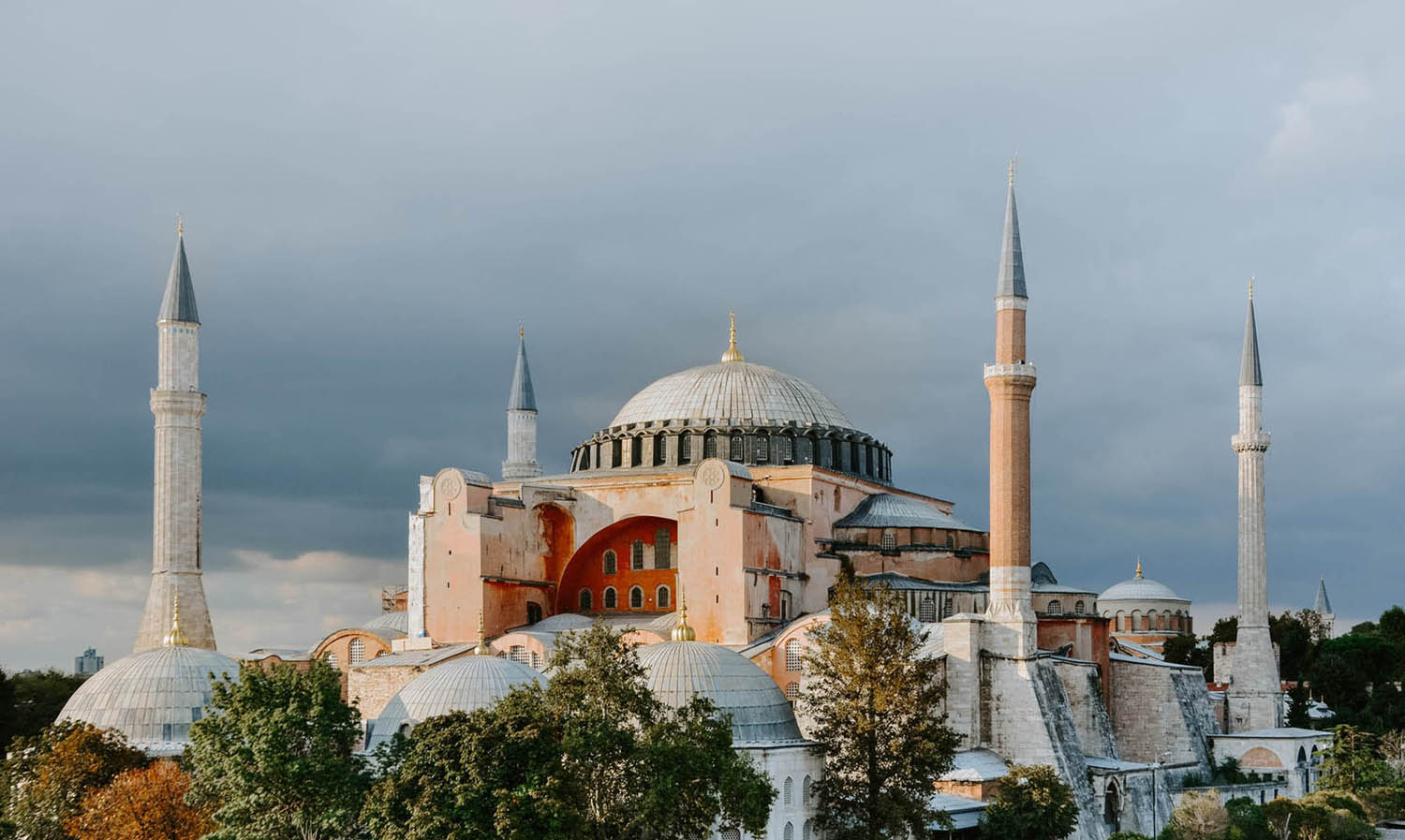
Above Hagia Sophia, Constantinople, whose greatest achievement was the conversion of the Russian peoples to Orthodox Christianity. In Rome, the popes put themselves at the head of the Church reform movement of the late 11th and 12th centuries. Under the aggressive Gregory VII (1073-85) and his successors the papacy began to enforce its will throughout western Christendom as never before. For Count Fulk Nerra of Anjou, who died in 1040 while returning from his last visit to Jerusalem, the pope of Rome was a shadowy and insignificant figure. However, for his descendant, Count Fulk V of Anjou, who ruled as monarch of the Latin kingdom of Jerusalem exactly a century later, the Roman popes were the undisputed leaders of Christendom and the spiritual sponsors of the crusading movement. |